Showing posts with label RGB. Show all posts

Wednesday, May 25, 2022

Severe wind across SC with isolated tornado/hail


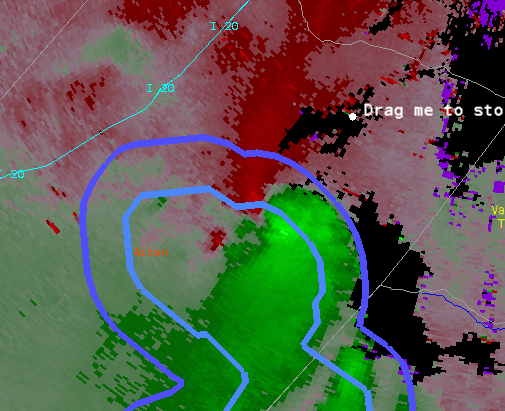
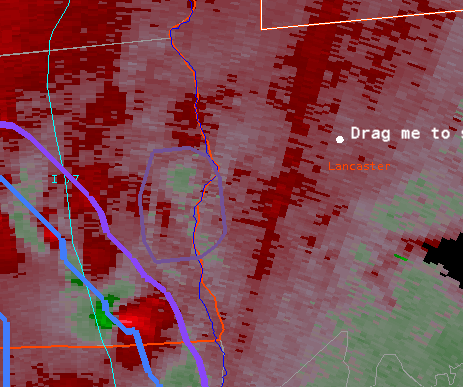
This was the lone tornado warning I issued. It was borderline but a nice MCV wrapped up after this. Likely contributed to some severe winds at times.
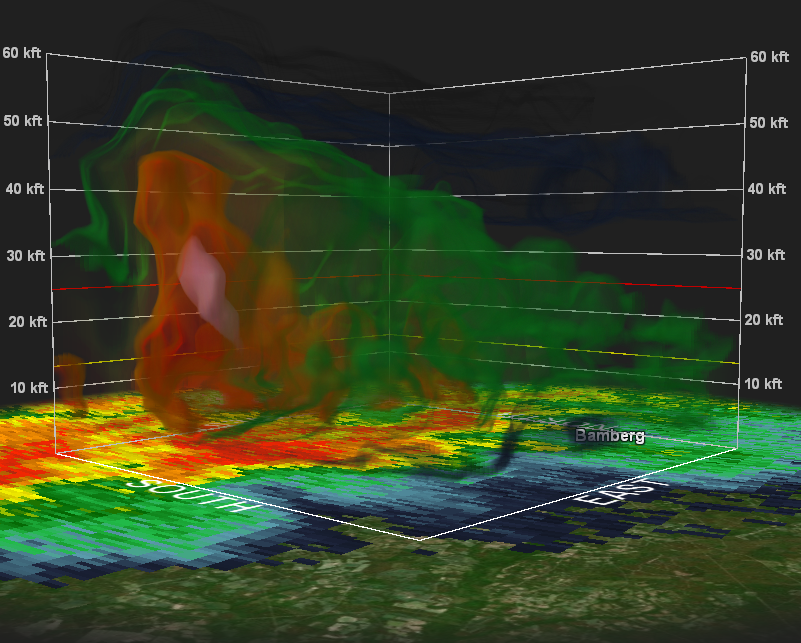
This helped lead to a warning at 2146 UTC. This cell was near our southern CWA border. This looked good for hail.
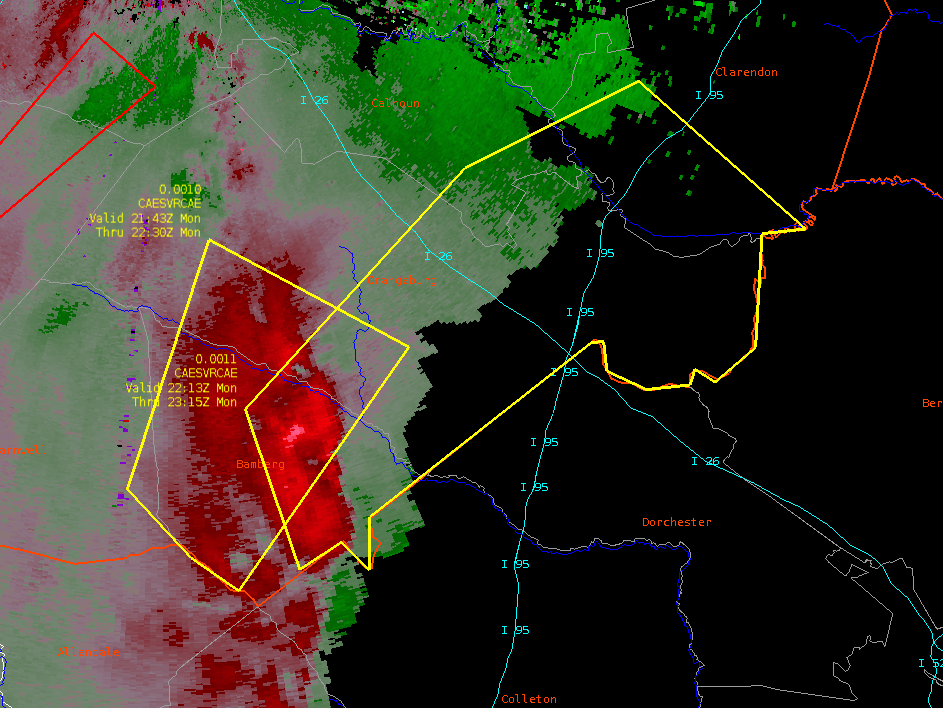
Here is the same storm a bit later when it's more of a wind threat. 40 kt winds showing up even with a poor radar angle.
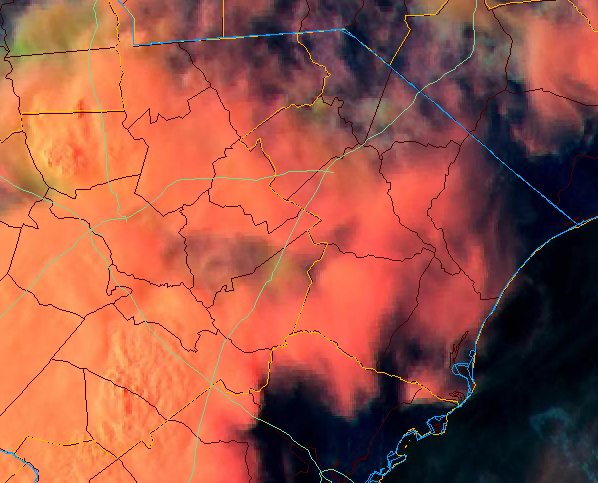

Good overshooting top with that same storm showing up nicely in the DCP.


Other notes. I liked the idea of the micro wind product but it’s too hard to read. Needs work to be usable.


One last minute tornado warning…

  • Some Random Guy

Tuesday, June 22, 2021

Use of Cloud Phase Distinction RGB to Anticipate Convective Initiation over Western Dakotas and Eastern Montana

 Some members of the 12z Thu Jun 10 HREF run were a bit slow in initiating convection or too far east in developing convection over the Northern Plains. The NSSL WRF-ARW was closest to reality with respect to exact timing and location. A special 18Z RAOB from Glasgow (GGW) MT and the Cloud Phase Distinction RGB proved to be very helpful in showing convection was going to develop earlier than anticipated by the HREF guidance. The 18Z RAOB from GGW (below) showed weak CINH values, while the Day Cloud Phase Distinction RGB (second graphic) showed an agitated cumulus field that was becoming quickly glaciated (single cell with yellow cloud top near the 93/61F sfc obs) indicating deep convective development was imminent.

Once deep convection initiated, single channel ‘Clean IR’ imagery and Day Convection RGB became more useful in determining updraft strength. These two products can be extremely useful in severe weather detection and warning decision making especially in absence of radar and/or lightning data or when used combined due to its faster temporal coverage (1-min in meso sector vs 5-min from radar).

The image above shows updrafts getting stronger in the 10.3 micron imagery (bottom left), and on the Daytime Convection RGB (bottom right) by evidence of yellow (red +green) pixels. Inflow feeder bands, a flanking line, towering cumulus above an invigorating RFD or flanking towers, and above anvil cirrus plume are also observed in the Day Cloud Convection and Cloud Phase Distinction RGBs (top panels) indicative of the storms likely being severe. In fact, the ProbSevere v3 and v2 output both indicated a very high probability of severe weather occurring with these storms with values over 90% (purple colors).

Thursday, June 6, 2019

Convective Intensity Continues to Diminish in Eastern, ID

The Day Convection RGB generally shows weak to moderate convection persisting over eastern, ID.  There are occasional new updrafts that develop, but are short-lived.  Combining the satellite trends with radar reflectivity generally depict that the severe threat has become isolated over eastern, ID.

Day Convection RGB loop.

Convective Intensity Waning across Eastern, ID?

The Day Cloud Convection RGB still shows updrafts persisting over eastern, ID.  However, the anvils of the existing convection are spreading over the area and potentially inhibiting afternoon surface heating.  GLM data has also showed a diminishing trend in activity.   Note, the GLM data did not load for the last few frames.

Flash extent density overlayed on Day Cloud Convection RGB.

Tall cell in western GGW's area


Strong updraft in western GGW showed the red colors going over to greens...likely the updraft getting into the warmer stratosphere.
Day cloud phase distinction loop over the area shows a continued strong updraft with gravity waves radiating outward.


Quite a bit of flashes in that cell in GGW.

Charley

Convective Threat for Eastern, ID

The day convection RGB depicts stronger updrafts moving from northern UT to southern ID as of about 2030z.  This area is under a severe thunderstorm watch with no warnings in effect at this time.

Day Convection RGB loop.

Cell Near Twin Bridges, MT, still not severe, though growing


IR shows that cell as having the coldest cloud top.  Donovan heights are around 20 kft for 50dbz to get 1" hail.  This cell is near it, but ProbSevere is not too excited about it just yet.  MESH is under dime-sized and thus ProbHail is 7% now.  Will monitor for further development.  Issuing SPS for pea sized hail now.

Pocatello Storms

We're currently monitoring conditions in eastern Idaho. Right now I'm using various applications to analyze and initialize current conditions. Currently AllSky is showing cape around 1000kj, and PWATS around .80 inches.


That PWAT value on the morning sounding just west of the area was close to .64". Seeing how moisture levels are lower to west I can interpolate that the moisture values are similar to what's show on allsky. The allsky 900-700mb also seems to pick up on the relatively moist area in the lower half of the atmosphere.


Looking downstream we're noticing a line of developing convection using the Day land cloud RGB. It's helpful to analyze just how high the tops of the storms are getting combined with cloud tops.
Zooming in closer I can examine the few storms that have popped up more closely. The RBG help the differentiate between the ambient cirrus clouds from the growing storms. That might not have been as easy to see using a typical visible view.


The AFA and Minimum flash area maximums are hinting at growing convection just downwind. That growth leads to me to anticipate further growth as these storms move into a more favorable environment in eastern Idaho.

Water Vapor Showing Jet over Pacific NW US


75-90 knot upper jet from morning raobs over the northwest US.  Shortwave trough moving ashore this afternoon with a small area of divergence moving into western WY.

Western Wyoming Cell Developing


IR imagery showing a taller/colder cell in western Wyoming.  KRIW radar just switched from VCP 35 to 12.  Peak Z aloft now only around 30.  Lightning data, below, shows relatively low FED, but higher TOE, with peak values in the 300's, similar to some of the storms we saw yesterday.


One other thing to note in these, is the relatively low FED and number of ENTLN/NLDN flashes.  That doesn't mesh with the brightness of the TOE.

Charley

Wednesday, June 5, 2019

Merger of storms


SPC issued a meso discussion talking about the threat for severe wind gusts on cells bowing out towards St. Louis.  The cell in Pike county on the look above has the outflow boundary tied into it on this RGB (in blue) and the updraft still is stronger with waves radiating out from the overshooting top.  We decided to issue a large SVR for winds traveling southeast out of this storm.

Line Running Into Drier Air?


IR and RGB imagery showing outflow coming out of the storms in the eastern LSX area not firing up additional storms.  NUCAPS 400-200 mb RH product shows quite a bit of drier air that the line is pushing into.  More moisture is west of the MO/IL line, so that part of the line may have a better chance to maintain themselves/develop new cores ahead of the line along that outflow.

Charley

Tuesday, June 4, 2019

Severe Threat over Minnesota This Afternoon


Ongoing complex of thunderstorms pushing into south central MN this hour.  Have a new set of thunderstorms forming in what AllSky is showing as a higher CAPE environment along the outflow pushing out from this complex.  ProbSevere has picked up on this cell as well (near Milan)...showing a Hail chance of 55% now and growing quickly.  Will monitor the downstream growth of both systems.

Monday, May 20, 2019

Let's do the wave

Seeing some interesting waves at different layers on the Simple Water Vapor RGB this evening. As a reminder, the simple water vapor RGB is made up of the low level water vapor image (band  10), the upper level water vapor image (band 8) and the clean window IR image (band 13).


There is one area of east/west waves along the Oklahoma/Arkansas border. The main contribution to those waves is the green channel, so we are "seeing" those waves based on the upper level water vapor.
The other is to the west of the severe convection in west Texas.  These waves have contributions from all the channels.

Thorcaster

Thursday, May 16, 2019

Earth Networks detects negative flashes in hail core

Over Indiana, there is a concentration of negative flashes where Minimum Flash Area is slightly larger.  This is colocated with a hail core shown in the Radar Hybrid Hydro Class.


-Jonathan Wynn Smith (ESSIC/UMD)

VisIR Sandwich of MCS

VisIR sandwich product has been a very useful way to combine the high res visible imagery with the cloud top temperatures. However late in the day as the sun angle gets lower, the image gets darker. One way to remedy this is to adjust the composite options (right click on legend), and equally lowering the Gamma setting. This will brighten up the image and allow better utility into the low sun angle hours before sunset.

Default:


After:


How to adjust settings:


-- warmbias --

Eye Candy - Nothing More, Nothing Less

#CaptionThis

#MarfaFront

Prob Severe Object Identification

Prob Severe failed to identify a strong storm developing in radar sparse coverage area near Bozeman, MT. The storm did show up on MRMS composite reflectivity, ENTLN, GLM Lighting and had rapidly cooling cloud tops, so not sure what was missing to have the storm identified by Prob Severe.


--warmbias--

Slight Risk West and East

Operating across the CONUS today with one team of forecasters located in Idaho/Montana in MSO and the other in Illinois (ILX).  The forecasters have also been encouraged to investigate the environments nearby their official CWAs including the ongoing MCS currently crossing the Chicago CWA.

SPC Day 1 outlook for 16 May 2019

For those in Illinois, the environment remains supportive of development  off of outflows from the ongoing MCS or other possible convection.   Though it remains likely that the MCS will continue to remain strong and pose  a threat for strong winds at least across the NE section of the CWA.

All Sky LAP CAPE

For Idaho, it currently remains rather calm, but the CAMS have consistently latched onto expected convection later in the day including supercell storms.

Sandwich IR/VIS product for Western United States

-Kristin

Pinwheel Fronts In The Dakotas

Mid afternoon into early evening saw a bretty good bloom of supercells along a SSW-NNE Cold Fronf in North Dakota...


Thru the period the SVRProb and SVRtor seemed to regularly over warn during this outbreak, BUT SVRHail was spot on, a little False Alarm-y, but it sure didn't miss the Large Hail reports, with %s >90 both instances.  The RGB Day Convection GOES product seemed to respond pretty well with the hail instances as well.


Afternoon NUCAPS over forecast the CAPEs by ~ 500, PW by 0.2", did well with the Downrush temp and DCAPE tho.