Thursday, June 8, 2023

CHS OCTANE Orphan Anvils

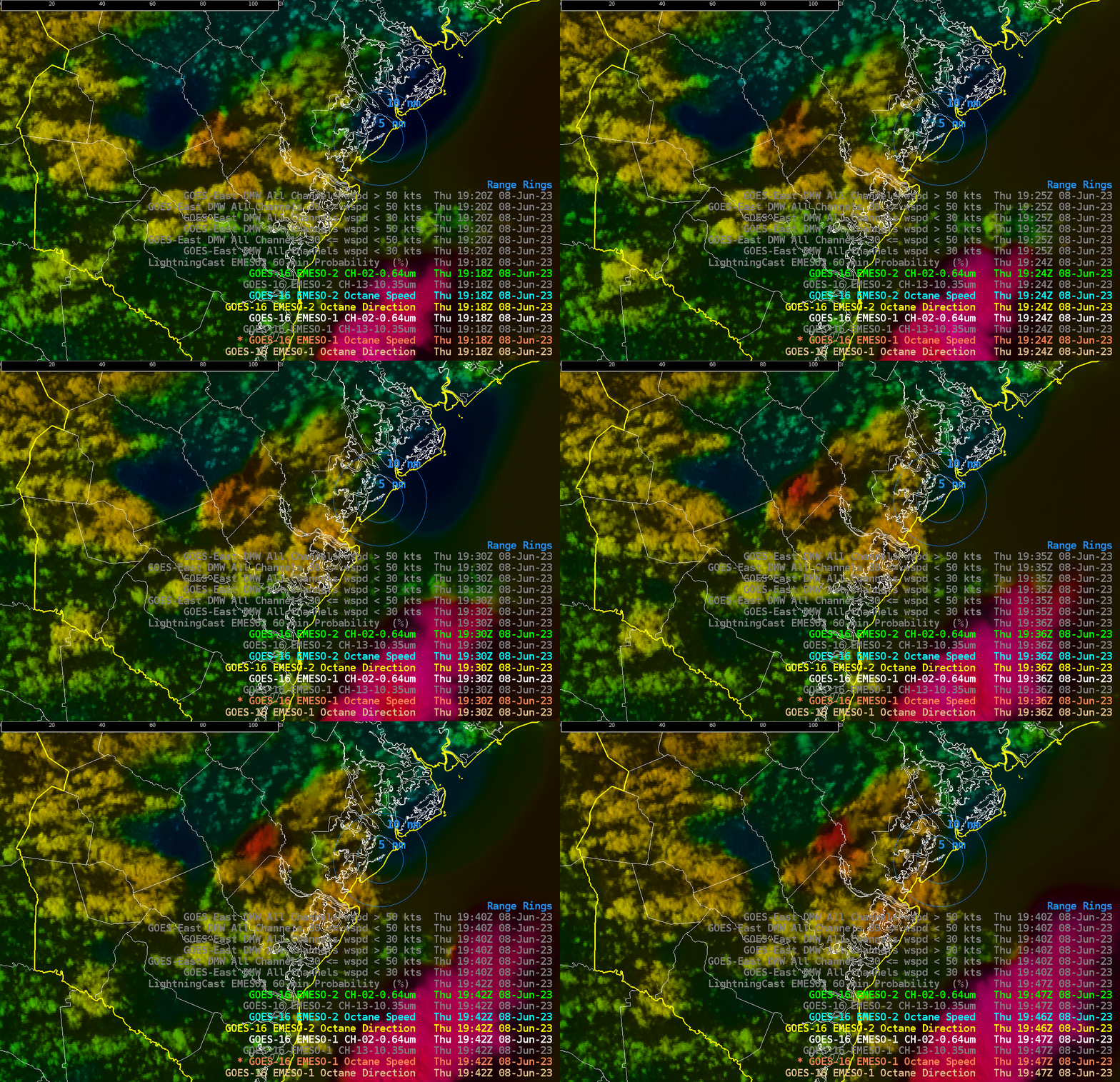
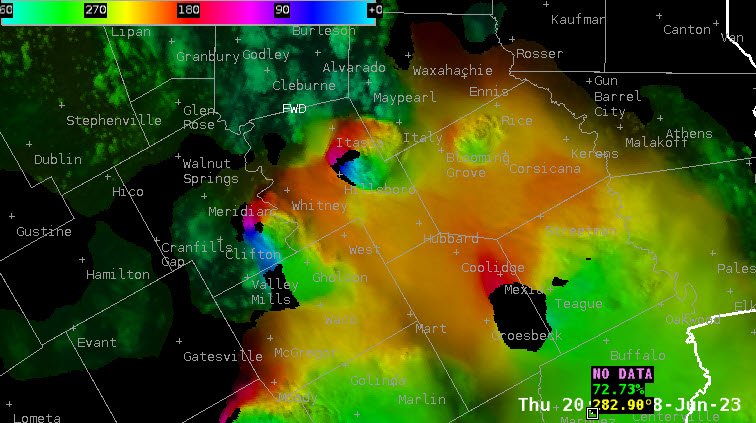
 While watching for convective initiation over the Charleston CWA, we noticed that the deepest convection over land started to produce orphan anvils; two of them during this loop. It made us curious if we could see any precursor in the OCTANE Speed Sandwich RGB to a developing orphan anvil. At the typical color bar range of 0-200, it was minimally visible, but as we shrunk the range, a precursor became more evident. The example here has a range of 0-75. Note the cell in the center of the screen. At the beginning of the loop an orangish reddish color can be seen just before the orphan anvil develops, then a more noticeable color enhancement can be seen as another anvil is about to be orphaned. From a forecaster standpoint, knowing anvils are about to be orphaned can be helpful to know that a particular cell is not likely to intensify and will probably diminish. Although orphan anvils can be seen with the OCTANE Speed Sandwich, orphan anvils still may be better seen in day cloud phase or day cloud type RGBs.

OCTANE Speed Sandwich loop of two orphan anvils developing.

- Burton Guster & Displar

Severe Storms over Central Texas.

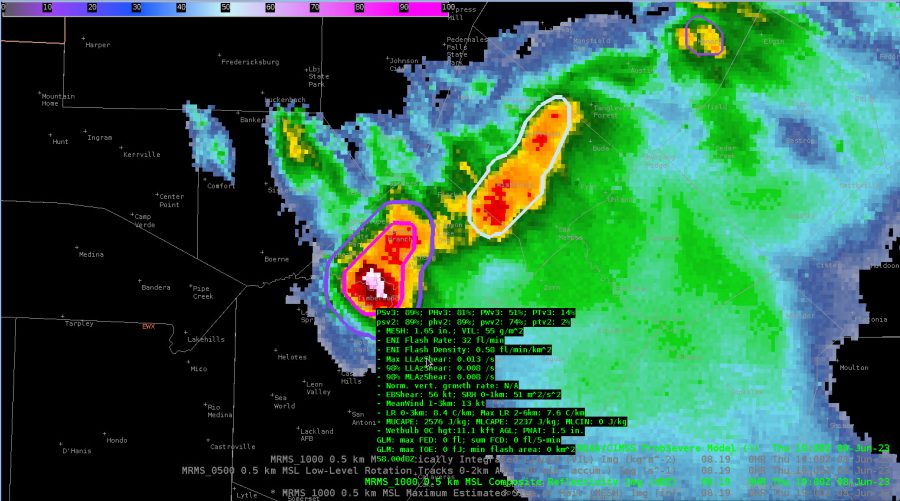
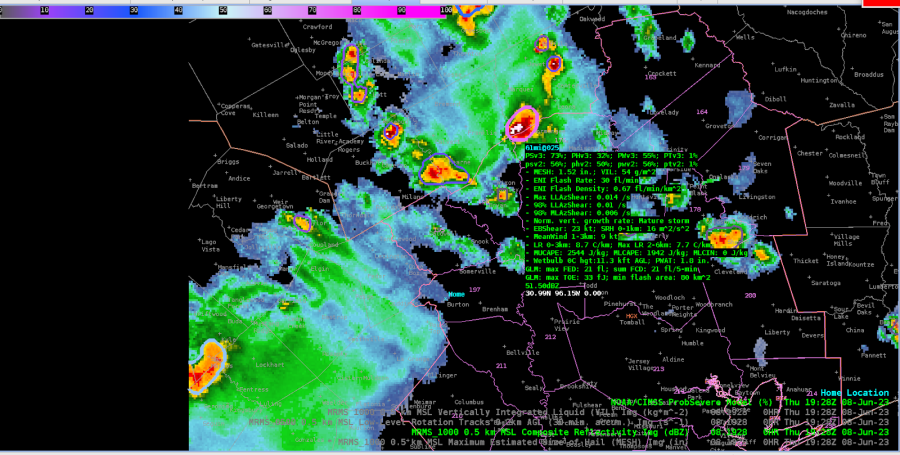
 Storms over northern Bexar and southern Comal have had hail up to golfball size reported. This is in good agreement with the MESH signature. Additionally, Prob hail for both v3 and v2 are up over 80%, so in good agreement with the algorithm.

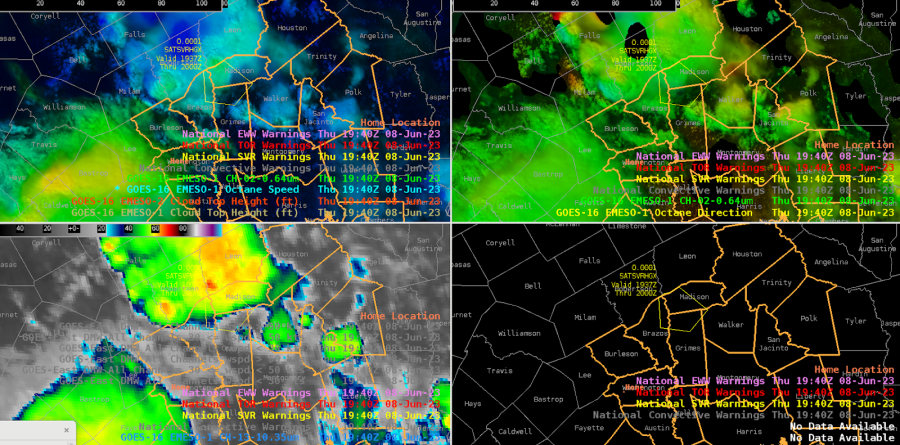
Animation of storms with the latest OCTANE. Looks like storm top divergence can be inferred from 70 kt anvil level winds to the south and 30 knot winds to the northwest. Would equate to strong divergence aloft and indicative of a severe storm.

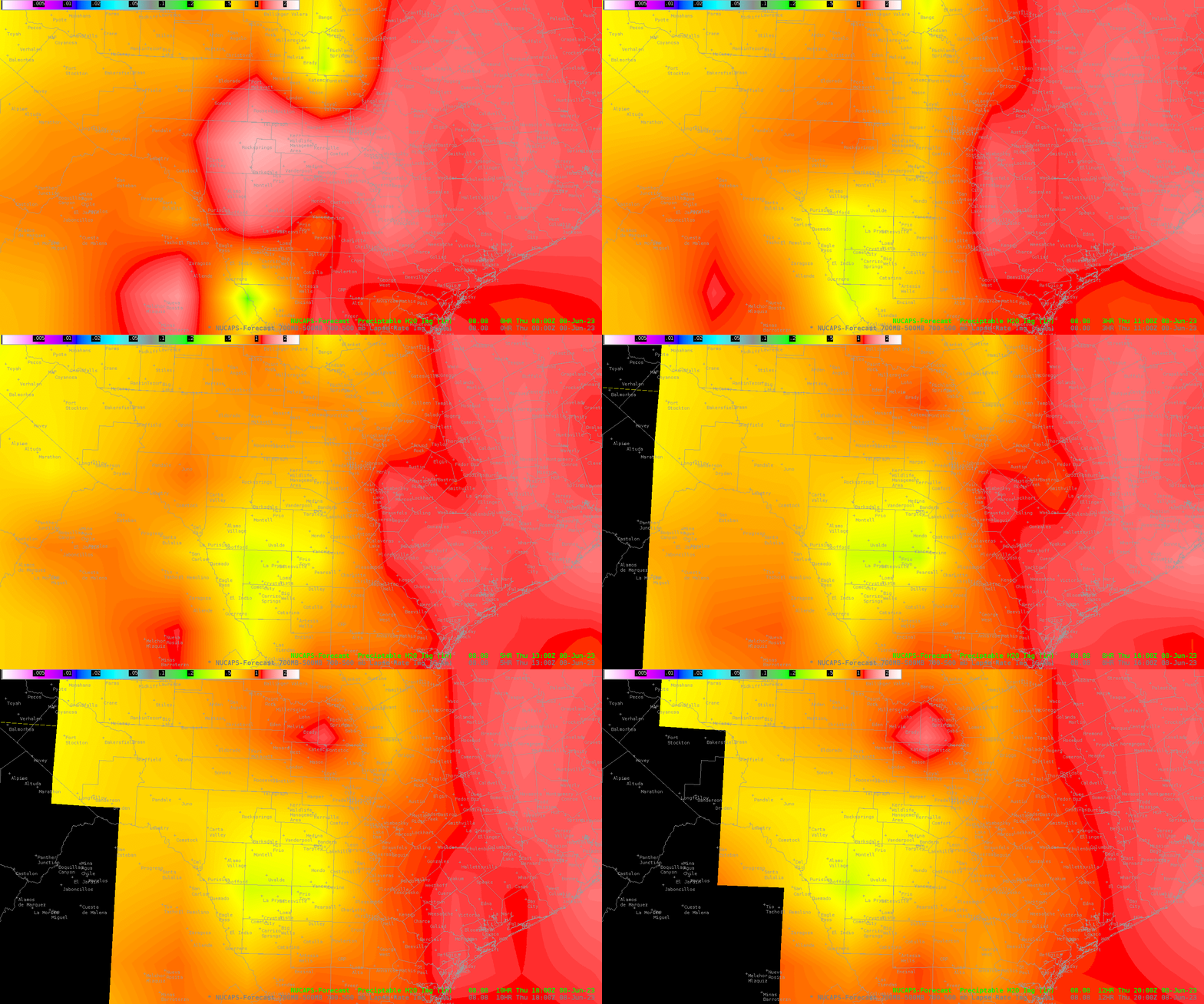
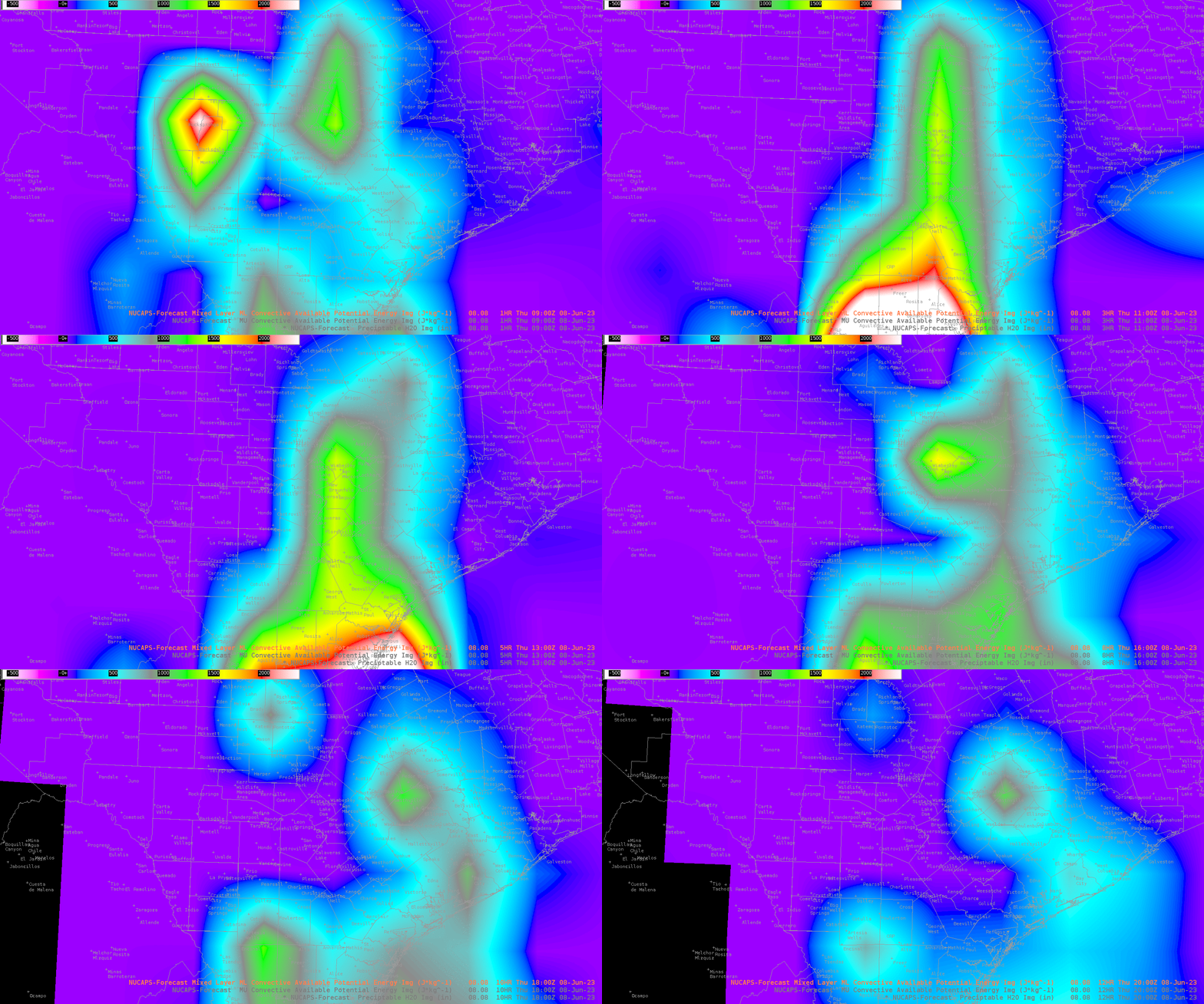
The 08Z Pass of NUCAPS shows a rather impressive PWAT/Moisture gradient this morning, which would likely lead to increased storm chances along the theta gradient over the Hill Country and stretching eastward into the I-35 Corridor. The gradient ranged from 1.25” over the Coastal Plains to .50” over the Edwards Plateau and western EWX CWA.

This ties in nicely with the MLCAPE available this morning.

Storms going up in a weaker shear environment with a rainbow color distribution all around the storm from the OCTANE direction window. Very interesting. You may actually be able to infer the type of storm/environmental conditions just based on OCTANE direction depending on the situation.

- Satellite Steve, StormofCentury , Bolt

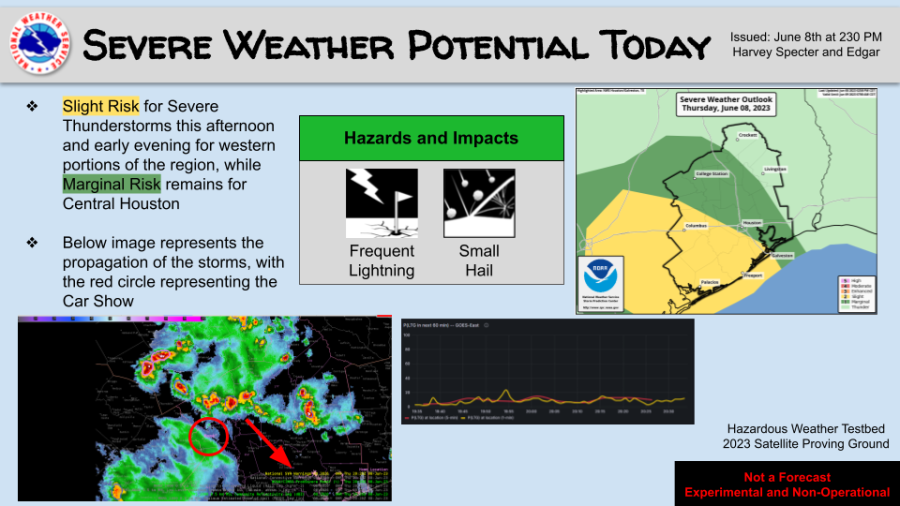
HGX Convection impacting the Car and Truck Show in Burton, TX

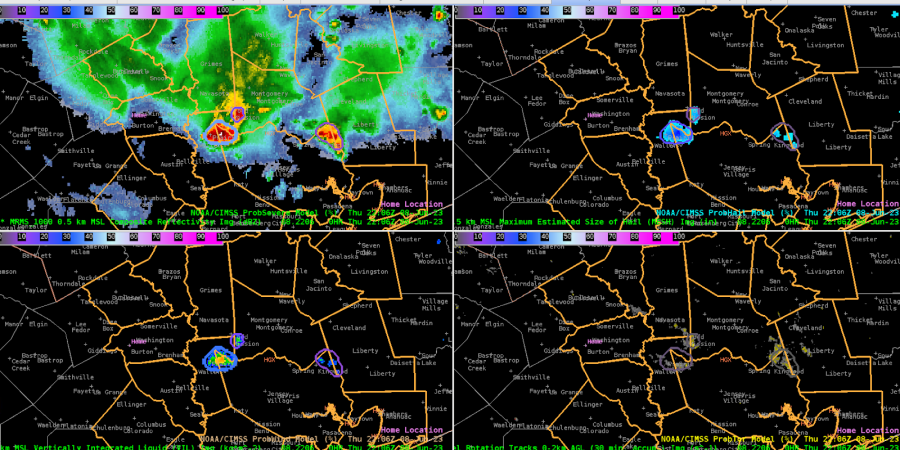
 Initial setup for the HGX vicinity showed several cells to the north and east of the DSS site, propagating southeastward. The strongest cell, pictured below, had a PSv3 of 73%, while PSv2 remained as 56%.

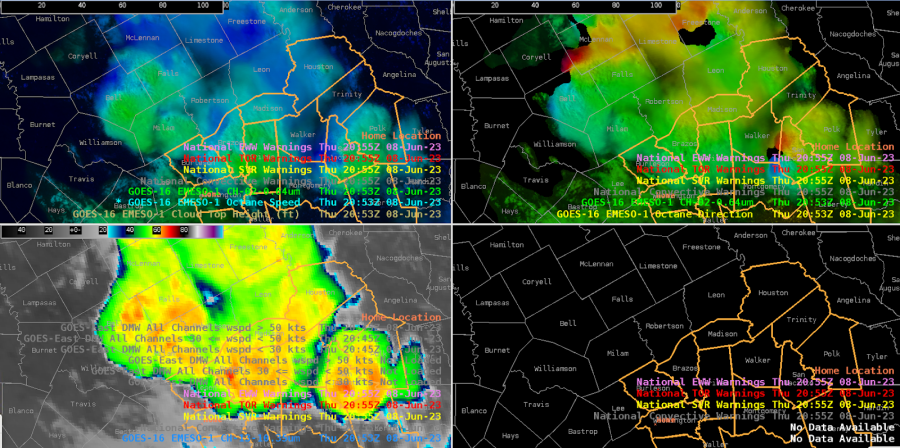
We issued a warning for a northern cell moving into the CWA into Madison county, based on a -70C cloud top brightness temp and PSv3 total prob over 70% (had been climbing from the 50s fairly steadily). But the cloud top shear noted by Octane was not strong (~20-25 kts), so the warning was very borderline. Just a couple scans later, it lost most of its texture on the vis imagery and lost its shear in the Octane direction product. Cloud tops warmed a bit as well.

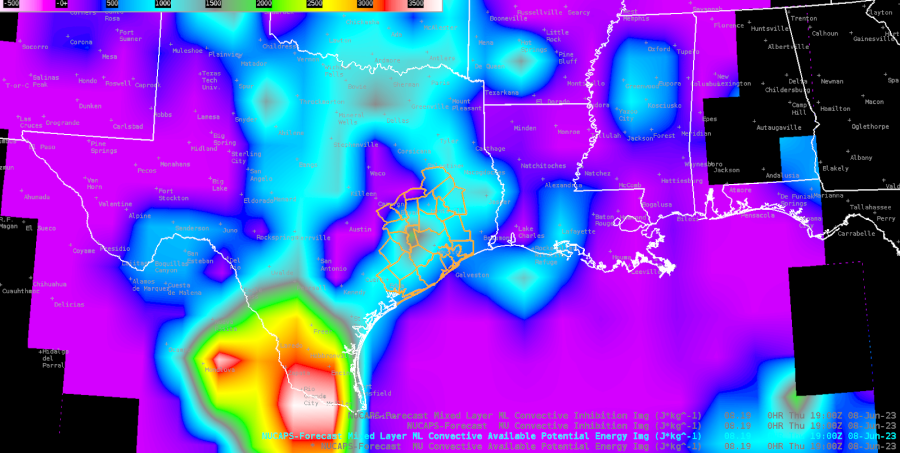
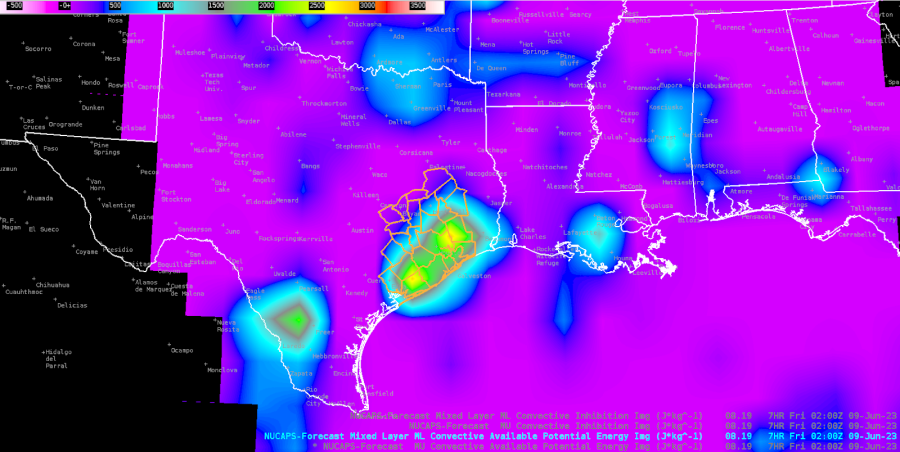
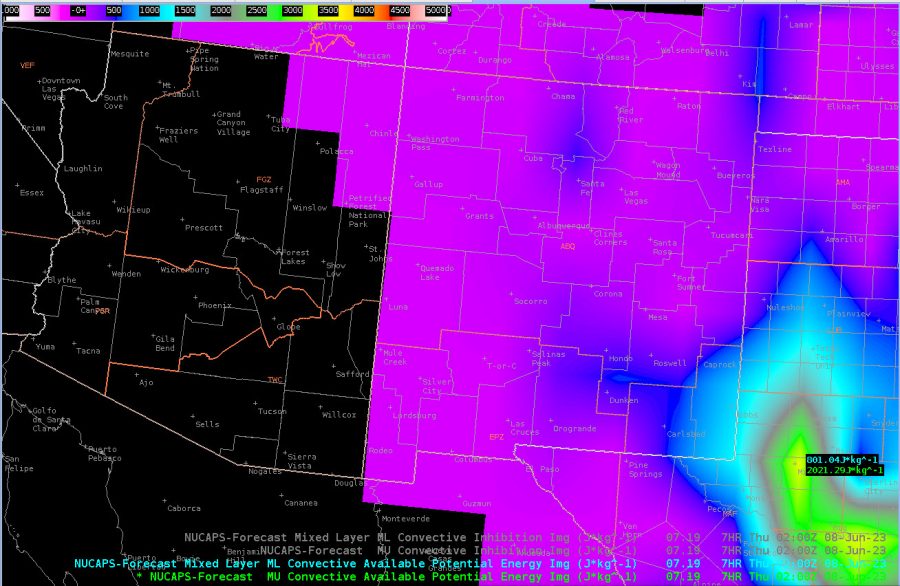
00H NUCAPS-Forecast (NF) is showing moderate CAPE now (1st image below), which may help explain the messy sub-severe multicell clusters, but the forecast valid at 02z this evening shows a resurgence in the CWA (2nd image below).

Looking to our NW, one of the stronger cells is outside our CWA, but the Octane direction is showing good cloud top diffluence.

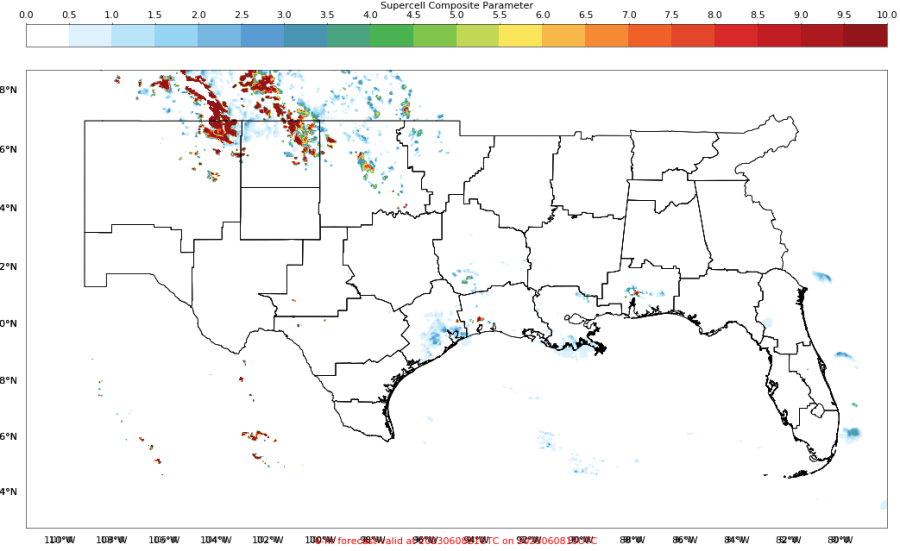
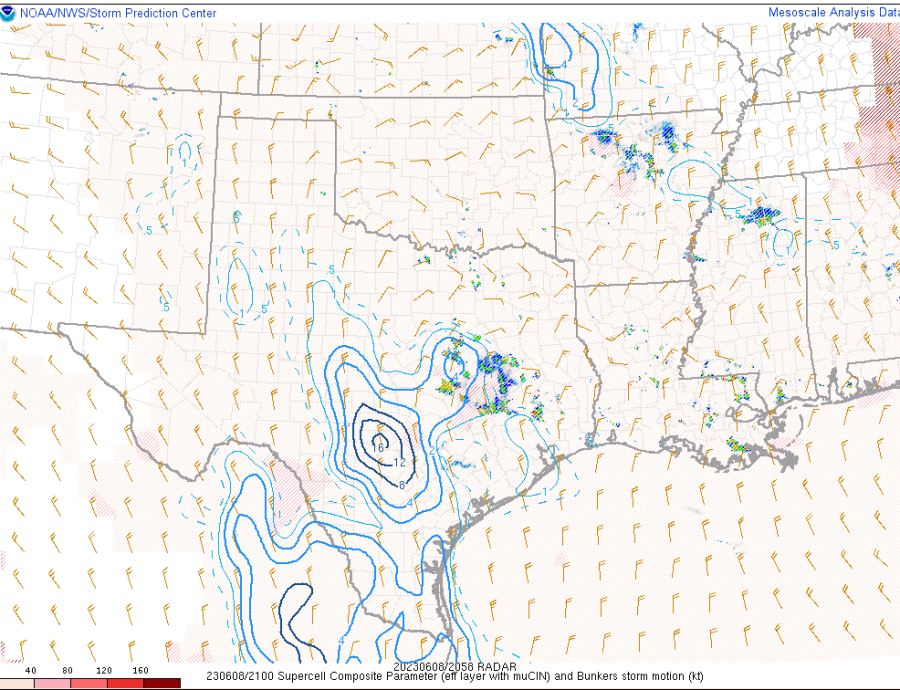
The PHS SCP forecast valid at 20z looks to be around 2-4 over our area, although this doesn’t match well with the SPC meso page SCP, which focuses high values W of our CWA.

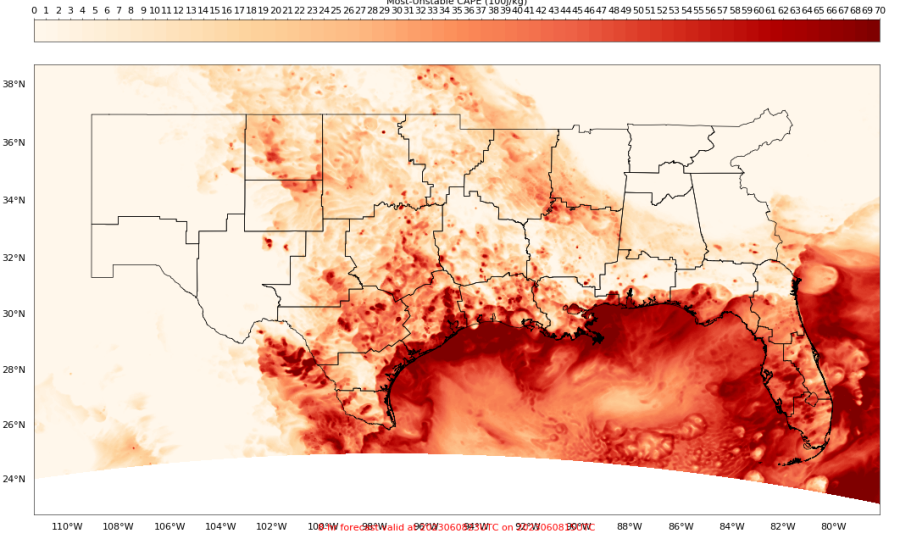
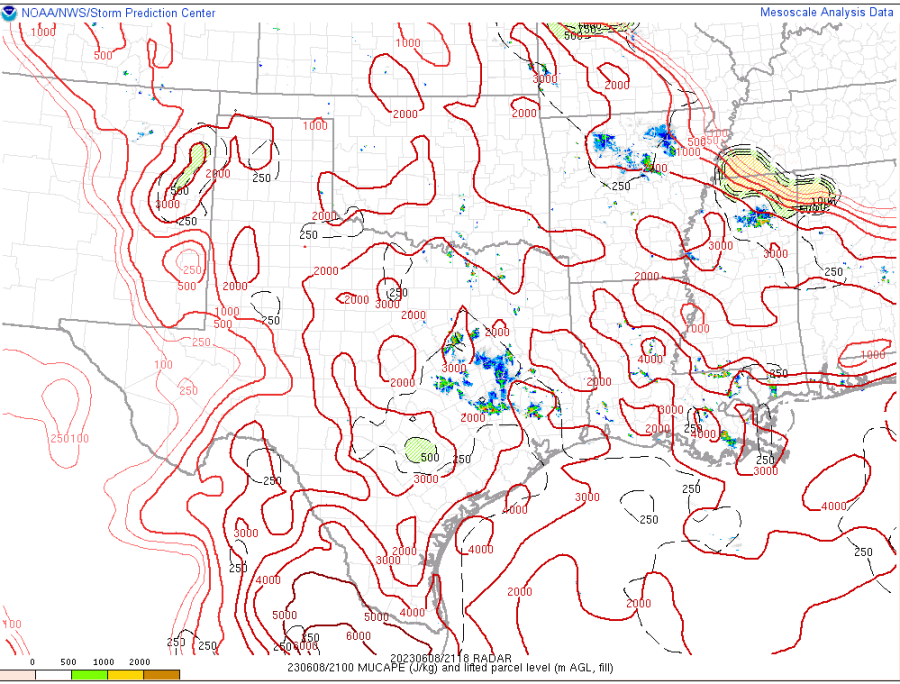
The 21z PHS MUCAPE (15z run) looks like it has insane values of 6000-7000 J/kg near the coast and just offshore. This is much higher than the SPC meso page, showing 3000-4000 J/kg at most.

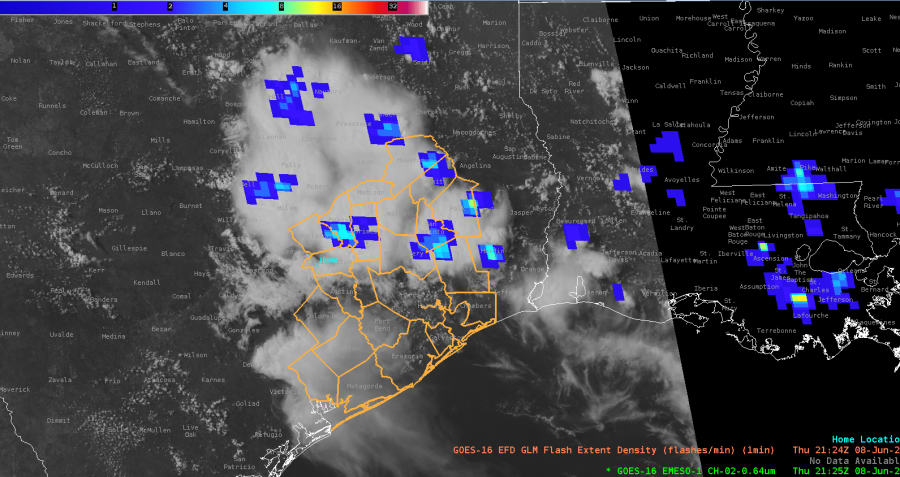
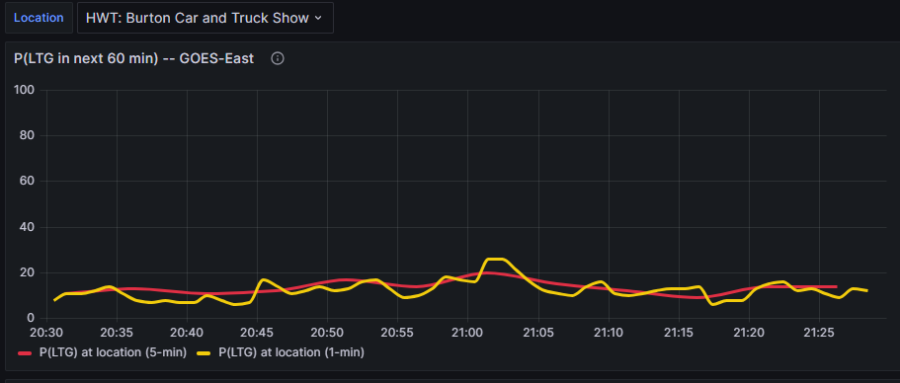
Looking at the optimal application of LightningCast, it seems that the point-based meteogram would work best for CI and in situ developing convection, versus storms propagating into the area. In our case here, at the DSS site, the point-based LC probs are low, suggesting little concern. But we can see from the GLM FED data that there are mature cells with lightning just to the NE that will probably move near the site in the next hour, which certainly poses a safety concern.

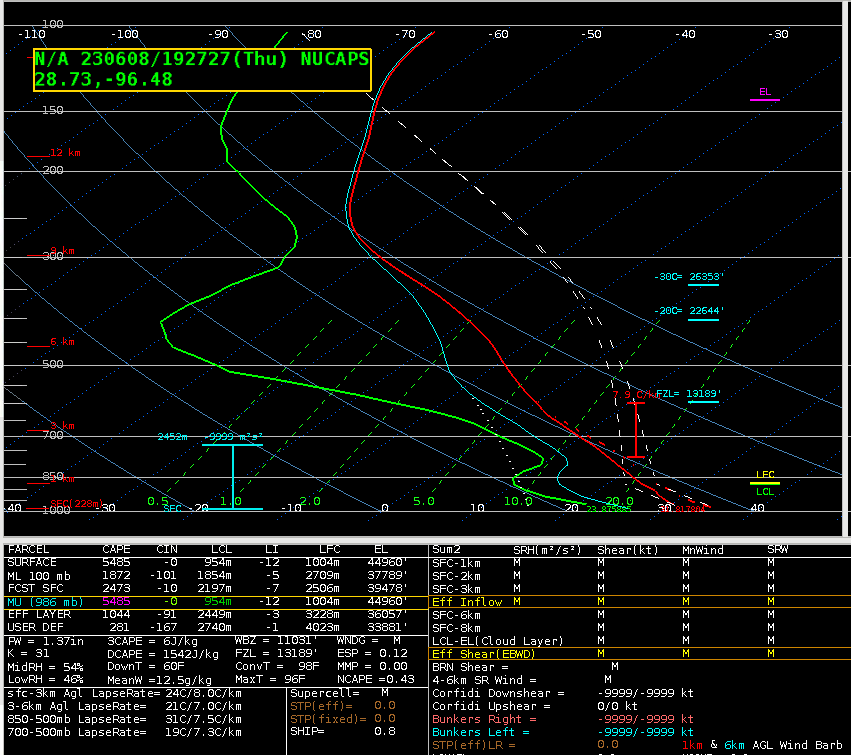
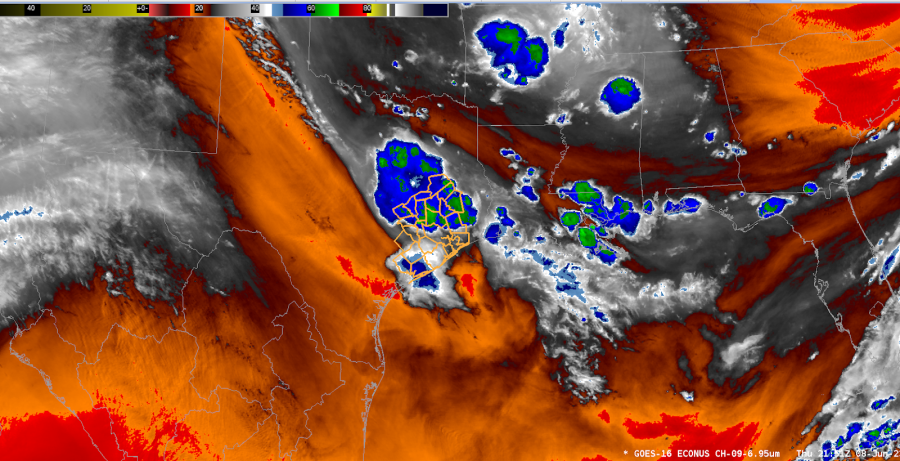
The NUCAPS sounding near Victoria (far SW CWA) showed a lot of CAPE and DCAPE, but a rather dry profile. This is confirmed by WV imagery over much of far S TX.

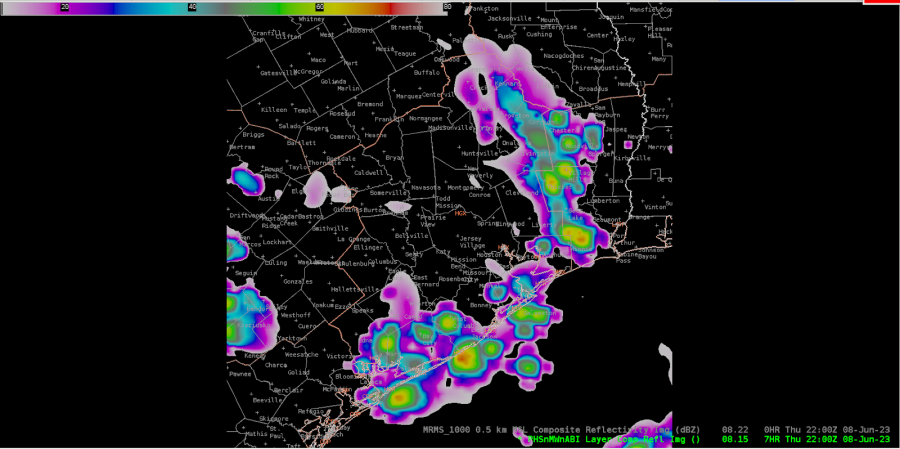
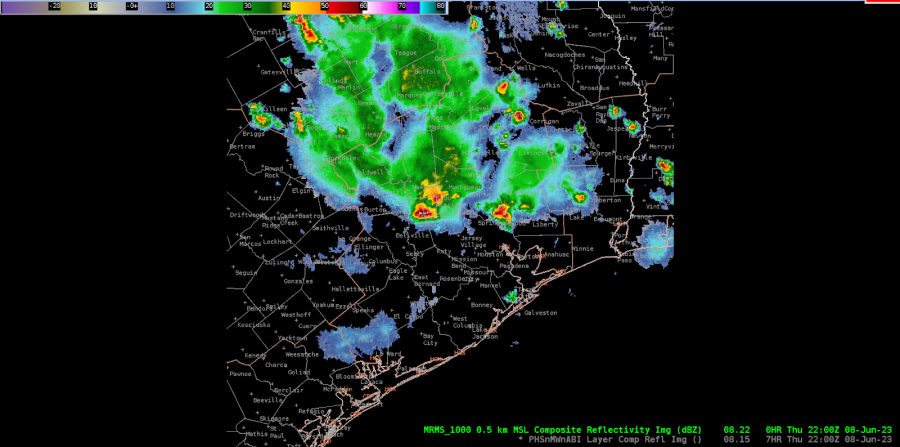
22z PHS Composite Reflectivity (above image) compared to 22z MRMS Composite Reflectivity (below image ) depicting PHS struggling on timing as the cluster of thunderstorms propagate from northwest to southeast.

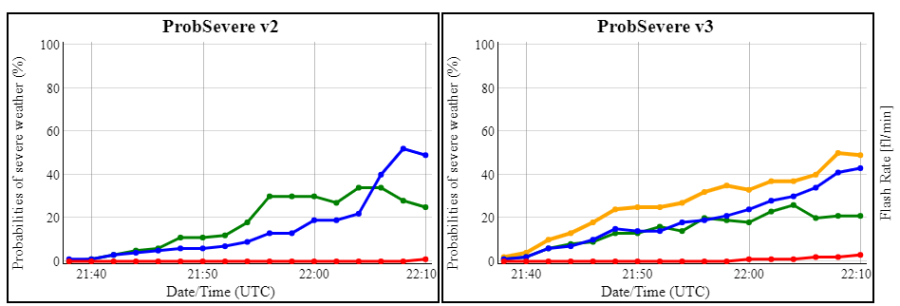
Late in the event, this cell is showing slow strengthening on PS -- currently both v3 and v2 have 40% total.

- Edgar and Harvey Specter

Monitoring lightning in Texas

Our teams in Texas are monitoring for severe storms and lightning at two DSS events: the "Come and Take It!" Celebration, in Gonzales, TX (point A in Figure 1), and the Burton Car and Truck Show, in Burton, TX (point B in Figure 1).

Figure 1: ProbSevere LightningCast probability of lightning contours (blue=10%, cyan=25%, green=50%, magenta=75%), GOES-16 ABI daytime cloud phase distinction RGB (background), GOES-16 GLM flash-extent density (orange foreground).

The LightningCast time series at the "Come and Take It!" Celebration is showing an upward trend in lightning potential (Figure 2, top panel). There have been a few anvil flashes within 10 miles already, as observed by ENI (bottom panel).


Figure 2: Meteograms of LightningCast probabilities (top panel) and observed lightning (bottom panel) for a DSS event in Gonzales, TX.

ProbSevere v3 showing improvement

While the HWT forecasters didn't operate in North Dakota or South Carolina yesterday, I wanted to document several cases where Probsevere v3 (PSv3) was making improved predictions of severe weather, relative to ProbSevere v2 (PSv2).

In eastern North Dakota, very modest shear under a ridge helped these storms to get a little organization. Though PHv3 and PWv3 are rather low, the overall PSv3 probability was 44%, compared to PSv2 of 14%. Soon after the image in Figure 1, golf ball-sized hail was reported. In this storm, the low effective shear and lightning flash rate (12 fl/min) were hurting PSv2, while the MESH, ENI flash rate, low-level lapse rate (8.7 C/km), and decent mid-level azimuthal shear were the top contributors to the probability of severe. 

Figure 1: ProbSevere contours, MRMS MergedReflectivity, and NWS severe weather warnings.


A little further west and about an hour later, another storm showed a nearly 40% difference between PSv3 and PSv2 (50% vs. 13%). Despite a better flash rate and 1" of MESH, PSv2 was again hampered by low effective shear. Similar to the previous storm, the low-level lapse rate, MESH, and flash rate were helping PSv3. But in this storm, a strong satellite growth rate (not displayed in Figure 2) was the 5th leading positive predictor. Soon after the image below, there were two reports of semi-trucks blow over. Interestingly in this storm, the GLM flash rate was very low (1 fl/5 min) compared to the ENI flash rate (34 fl/min). This is another example showing how using data fusion helps create a more robust probabilistic model---when one data source is suspect (for whatever reason), others pick up the slack. We have also seen storms where GLM flash rates are much higher than ENI flash rates.

Figure 2: As Figure 1, but for a second North Dakota storm.


Several storms in South Carolina were showing some good improvement as well. A storm entering western South Carolina was pegged at 35% in PSv3, while only 3% in PSv2, owing to low MESH (0.47 in), low shear (~20 kt), and low/modest ENI flash rate (16 fl/min). In PSv3, a combination of good satellite growth (the growth rate was older, so not displayed in Figure 3 readout below, but still used in the model computations), modest reflectivity-based parameters, and a solid low-level lapse rate (9.1 C/km) combined to produce the 35% probability of severe. Reports of multiple trees down came in soon after this image.

Figure 3:  As Figure 1, but for a storm on the South Carolina /  Georgia border.


Further east, a similar story, with PSv3 13% greater than PSv2 (43% vs 30%). Dozens of trees and powerlines were down from this storm. The probability of wind was much higher than the probability of hail in v3.

Figure 4:  As Figure 1, but for a storm in central South Carolina

An analysis that was provided in the training slides for PSv3 showed that improvement was greatest in the moderate MLCAPE and modest/moderate effective shear regimes, which these storms fit into. One other point to note is that while ProbSevere v2 is often higher on very strong and mature storms, we've seen that quite frequently, ProbSevere v3 ramps up in probability sooner than v2, which we feel is a very important distinction and improvement. While not explicitly shown in the animation in Figure 5, v3 was again a little ahead of v2 in these storms in southwest Texas, where one team of HWT forecasters was working.

Figure 5: An animation of ProbSevere v3 contours, MRMS MergedReflectivity, and NWS severe weather warnings.

LightningCast for DSS at HWT

Several forecasters at the HWT were using the ProbSevere LightningCast meteograms to help inform communication and decision-making in simulated DSS events.

In Albuquerque, NM, we simulated their famed International Balloon Fiesta. Several areas of terrain-based convection were in the vicinity, when agitated cumulus clouds started heading toward the event from the southwest (Figure 1; red dot is the event location). Despite partial obscuration of the boundary layer clouds from upper-level outflow of another cell, LightningCast could still "see" the growing cumulus clouds and gradually increased the probability of lightning in the next 60 minutes, with a rapid rise in probability from 20:55 to 21:00 UTC (see Figure 2). The first flashes within 10 miles were at 21:23 UTC.

Figure 1: LightningCast probabilities of lightning in the next 60 minutes (contours), GOES-18 ABI daytime cloud phase distinction RGB (background), and GOES-18 GLM flash-extent density (foreground). Red dot is location of the Albuquerque International Balloon Fiesta. 


Figure 2: Top panel: LightningCast probability time series for GOES-18 5-minute (purple) and 1-minute (green) sectors; Bottom panel: Time series for ENI lightning (orange) and GOES-18 GLM flashes (blue).


Near Boise, ID, the DSS location was the American Aquarium Concert. A weakening upper low still supported sufficient deep-layer shear to produce strong storms heading for the concert from the east-southeast (Figure 3). As the storms edged closer, the probability of lightning continued to increase gradually, until a rather rapid increase from 21:45 to 22:15 UTC, from 20% to 80% (see Figure 4), as the anvil of the storm and some adjacent cumulus clouds moved right towards the event location (red dot in Figure 3).

Both GOES-East and GOES-West captured the increasing lightning potential at the simulated DSS event about 20-25 minutes prior to the first flash within 5 miles of the event. HWT forecasters at one point noted that the probabilities in AWIPS were not lining up exactly with the probabilities in the time series tool. We explained that in AWIPS, the contours are parallax-corrected, while the time series LightningCast data are not corrected. Based on their feedback (and that of other forecasters), we aim to provide parallax-corrected data in the time series capability very soon. 

We hope these cases illustrate the potential benefit of using an on-demand time series capability where lightning potential can be quickly ascertained, for both lightning initiation and advection scenarios.

Figure 3: LightningCast probabilities of lightning in the next 60 minutes (contours), GOES-18 ABI daytime cloud phase distinction RGB (background), and GOES-18 GLM flash-extent density (foreground). Red dot is location of the American Aquarium Concert in Boise, ID.

Figure 4: Meteograms of LightningCast probabilities (top panels) and lightning observations (bottom panels) for GOES-East (left) and GOES-West (right), centered at the American Aquarium Concert simulated DSS event.


Wednesday, June 7, 2023

Albuquerque HWT

 Storms are exhibiting some decent shearing aloft over NW New Mexico when comparing to NE New Mexico. Something I might not have noticed had I not had this product as I don’t always have time to go into the SPC mesoanalysis and check various levels of shear values. The 0-8km shear values are in the 40-50 kt range, in agreement with the range of values noted on the speed shear values of OCTANE. See below.

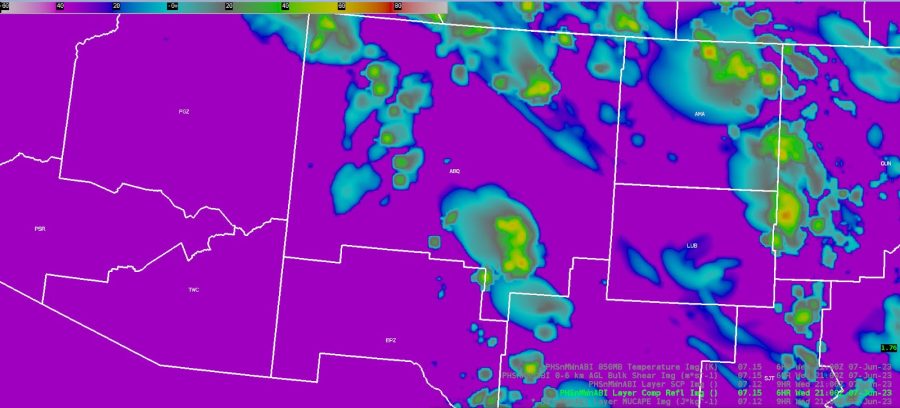
PHS really doing a nice job of pointing out peak areas of MUCAPE and where storms will likely develop. Decent scale and resolution results in some good quality comparisons with various other products. This is over the southern ABQ CWA.

Forecast Layer Comp Refl 21Z

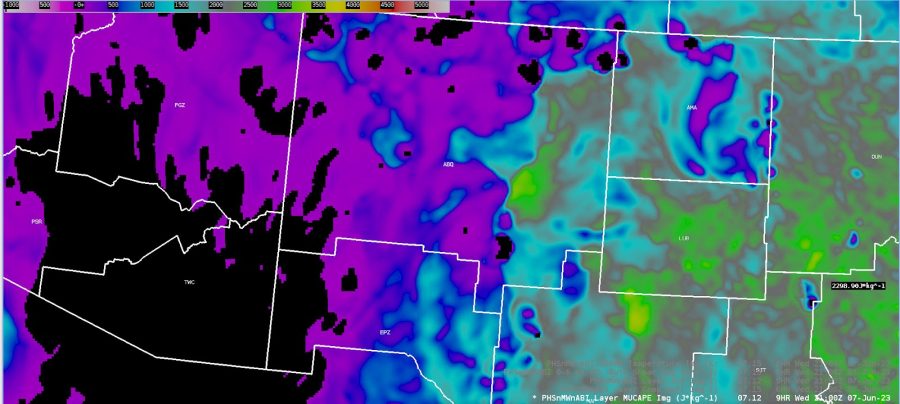
Forecast MUCAPE 21Z

Forecast MUCAPE 23Z - Also, noting a sharp gradient in MUCAPE values as convection strengthens over east-central New Mexico late this afternoon into the early evening hours. We will have to see how this plays out.

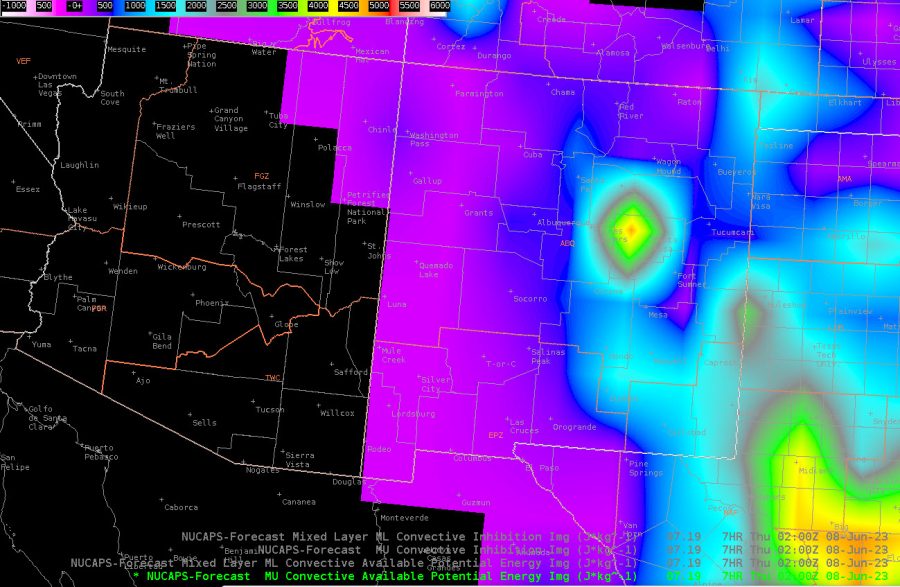
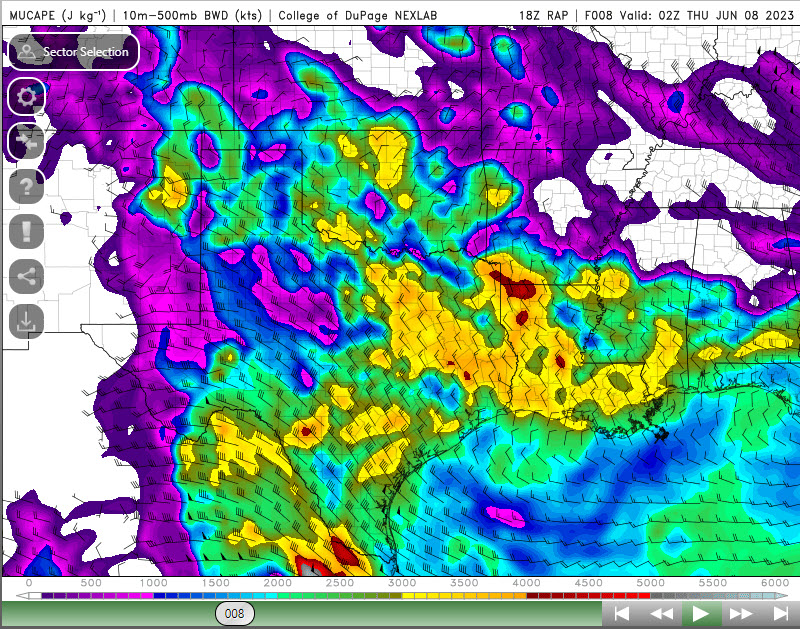
MUCAPE values seem a bit higher than they should be when compared with the MLCAPE values at the same times over New Mexico. I’m not exactly sure why the values are so high, but the forecast RAP values for the same time frame appear to be notably more displaced to the east and lower.

Example below from forecasted time 02Z.

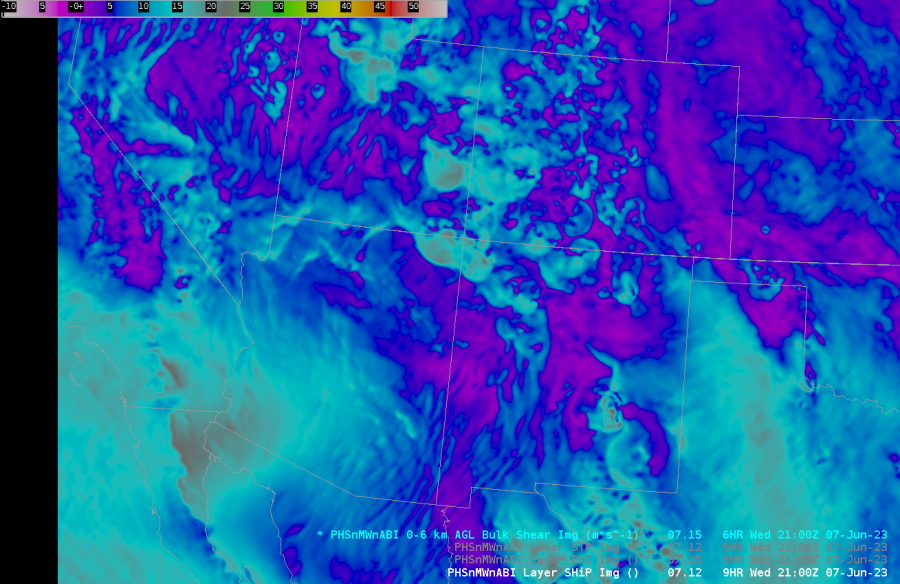
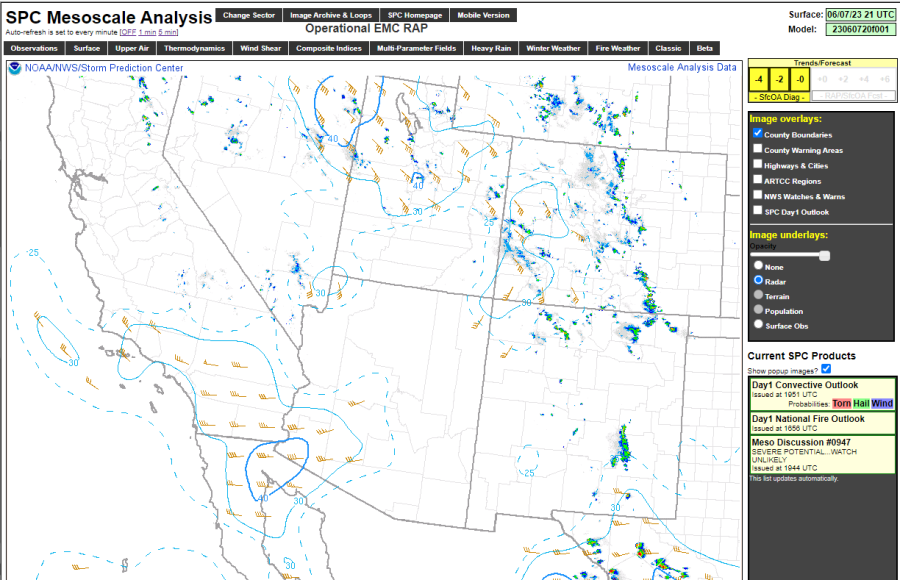
The 6 hour forecast at 21z of PHS 0-6 km Bulk Shear (first image) is compared against the 21z SPC Mesoanalysis (second image). Overall, the PHS forecast did quite well over New Mexico. There is generally little to no shear across the state except for near the Four Corners in the northwest and far southeastern New Mexico. The values are reasonable in these areas as well, around 16 m/s for PHS which fits in with the over 30 knot SPC values.These differences can be noted in the convection occurring as well (seen in the SPC image). Mainly isolated cellular over central NM, but showing more organization in the areas of higher shear.

-Satellite Steve and Burton Guster

Examination of LightningCast and OCTANE in Idaho and Oregon

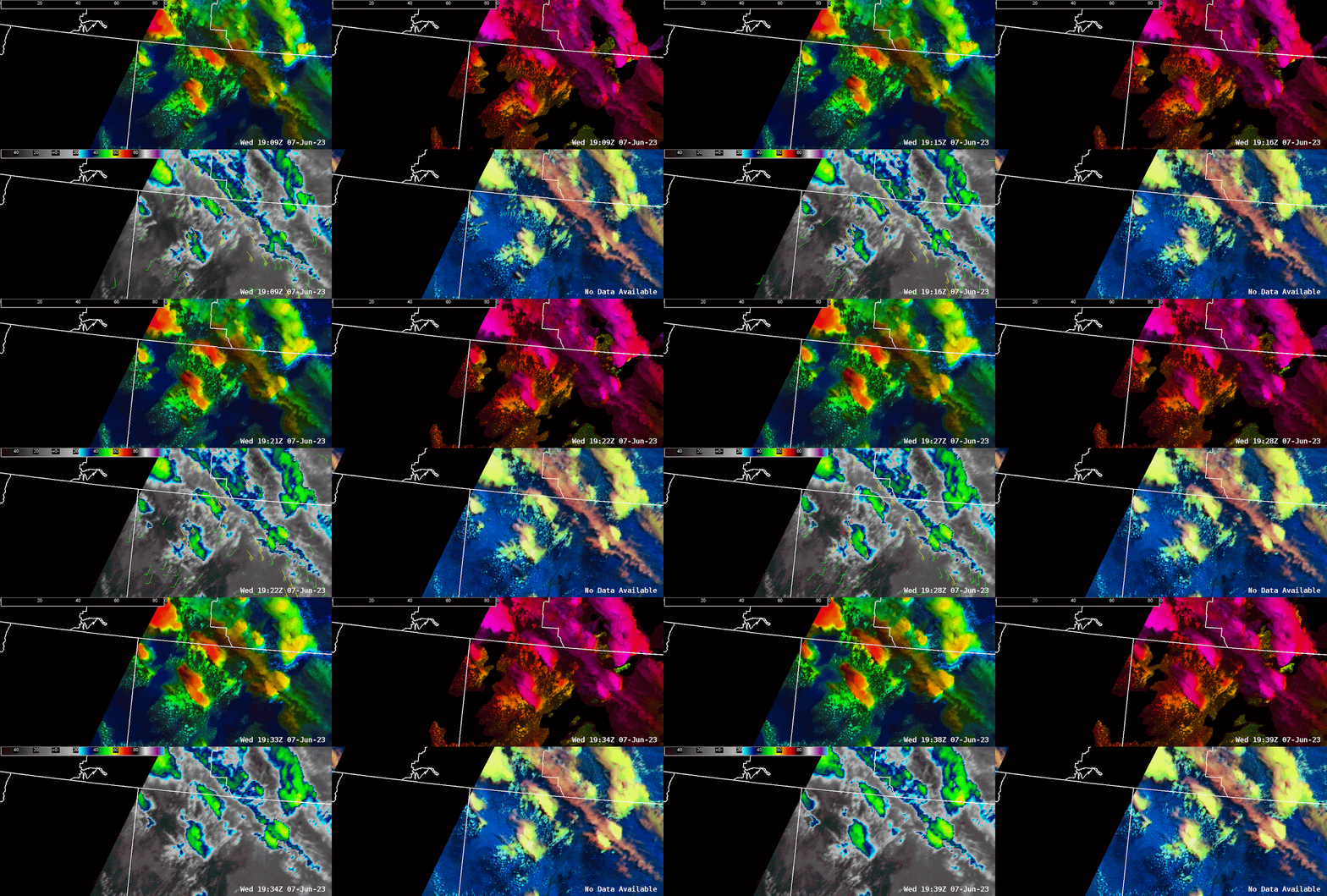
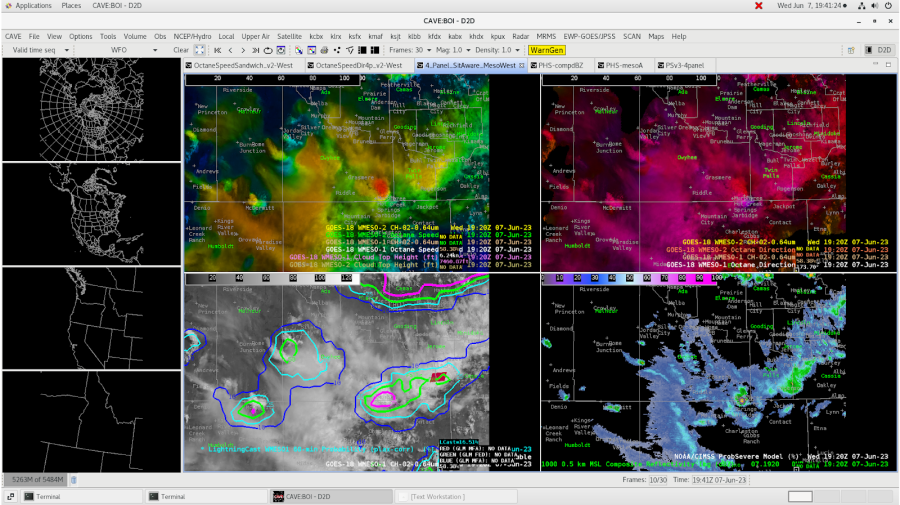
 Near the Idaho/Oregon border, we observed splitting cells on the afternoon of Wednesday, June 7. We believe we were able to see the first hints of this process get underway with the help of the OCTANE product. Subtle gradients were observed on the left side of the main storm prior to the ultimate cell merger. 

In the image on page 2, we see a nice comparison using LightningCast between an environment characterized by cirrus contamination vs an environment that was not contaminated. On the eastern side of the CWA that was characterized by cirrus contamination, LightningCast probabilities peaked at 50% on a storm that ultimately produced lightning. In contrast, two thunderstorms to the west (developing in a clear, cloud-free environment) both saw LightningCast values exceed 80% on two storms that ultimately produced lightning.
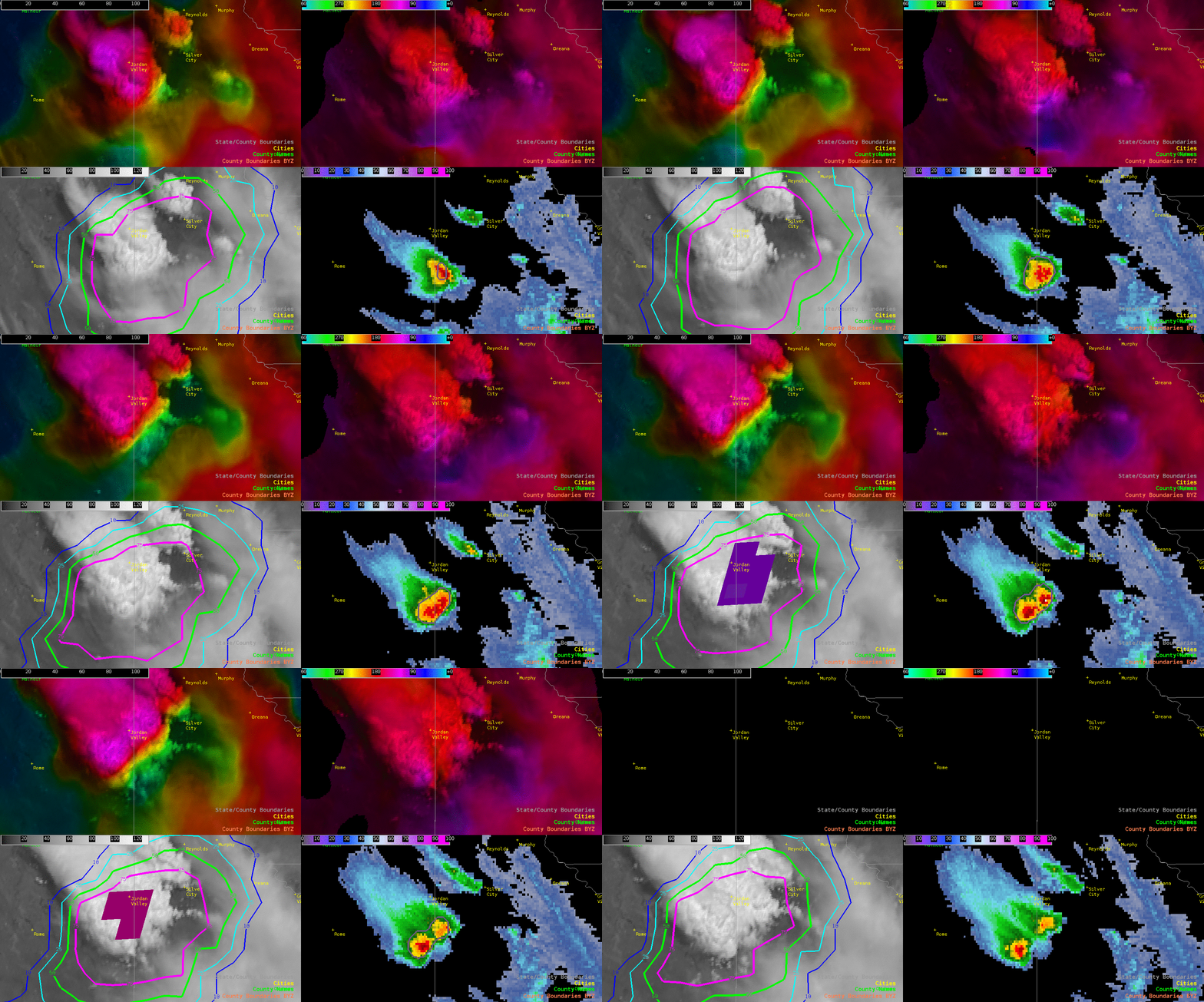
Above, we see perhaps the first instances of a splitting cell in progress, and OCTANE helped give us a first indication of the split (upper left in particular)
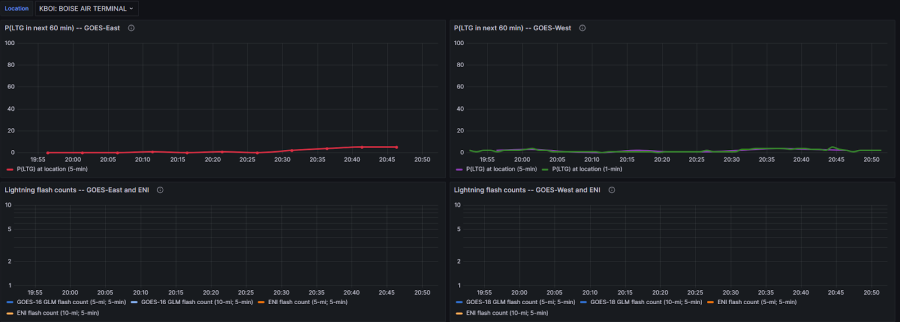
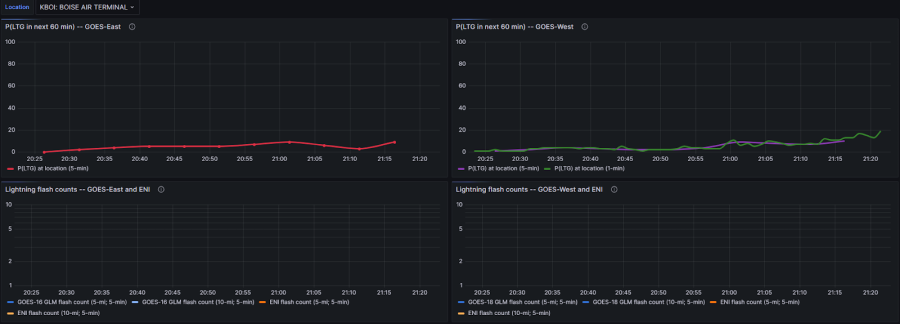
Above: LightningCast Meteogram as of 2053z, depicting a small trend upwards, albeit extremely minimal, within the next 60 minutes for some lightning impacting the American Aquarium at Hayden Beverage in Boise (DSS location).
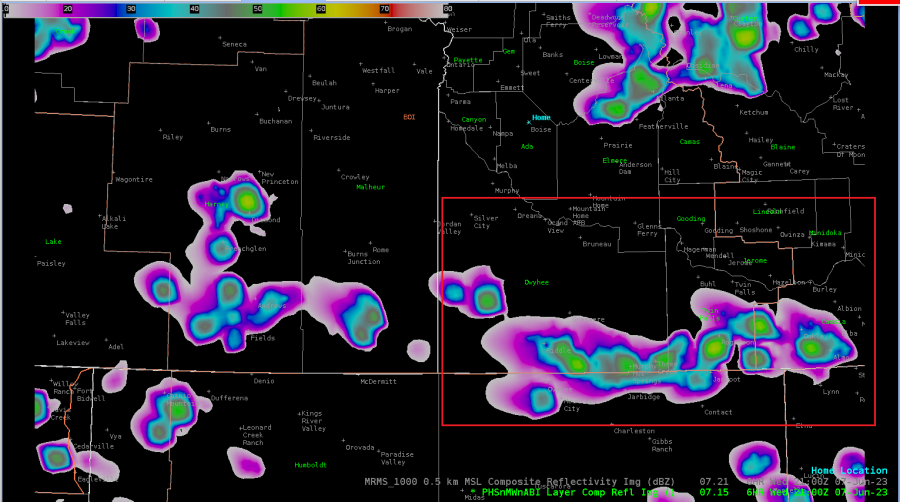
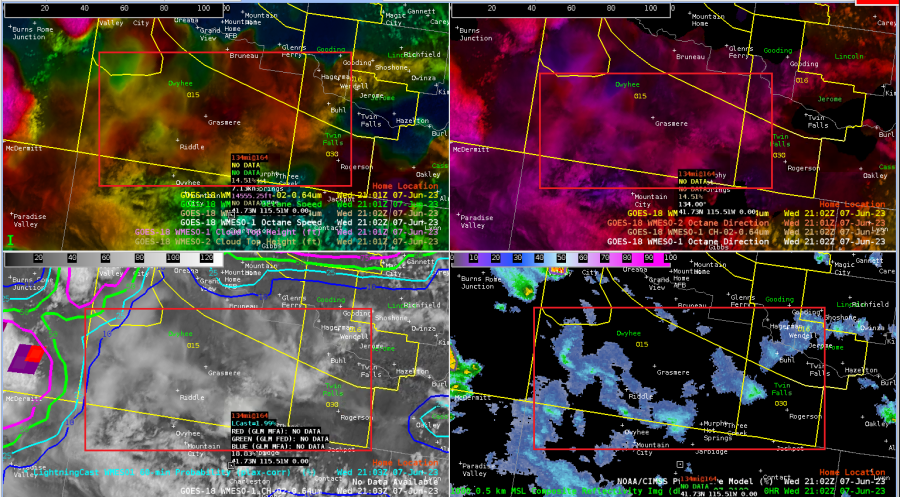
Above: 21z PHS shows development of convection in Owyhee and Twin Falls counties (southern BOI CWA) depicted by a red box; however, the 4 Panel Situational Awareness is indicating that doesn’t seem to be the case, with mere cirrus cloud development. Perhaps the timing is off?
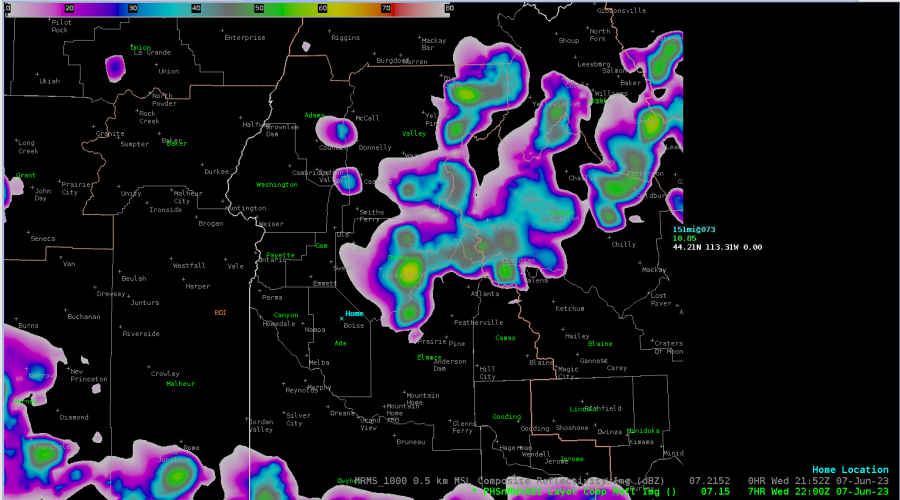
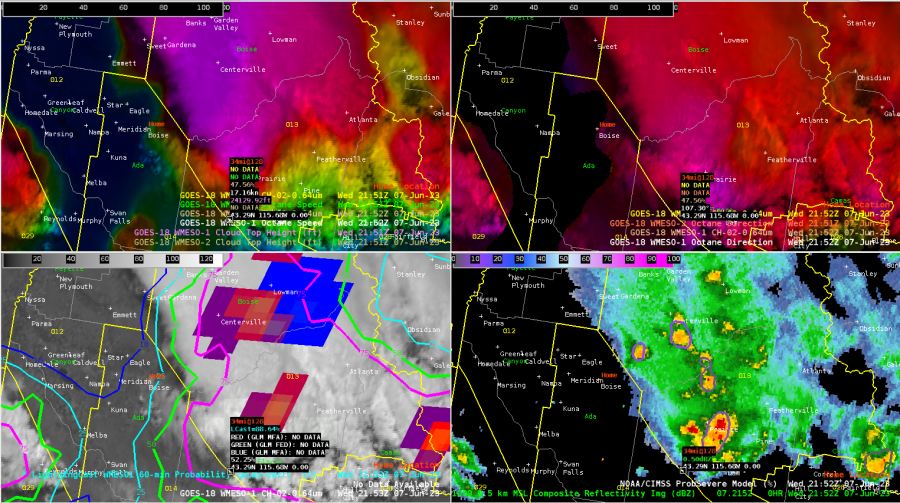
Above: On the other hand, PHS is doing a fairly good job depicting the convection just east of the DSS site. Currently (almost 22z), a few decent cells depicted by ProbSeverev3 (right around 15-18% probability, where MESH values are just over 0.50”)
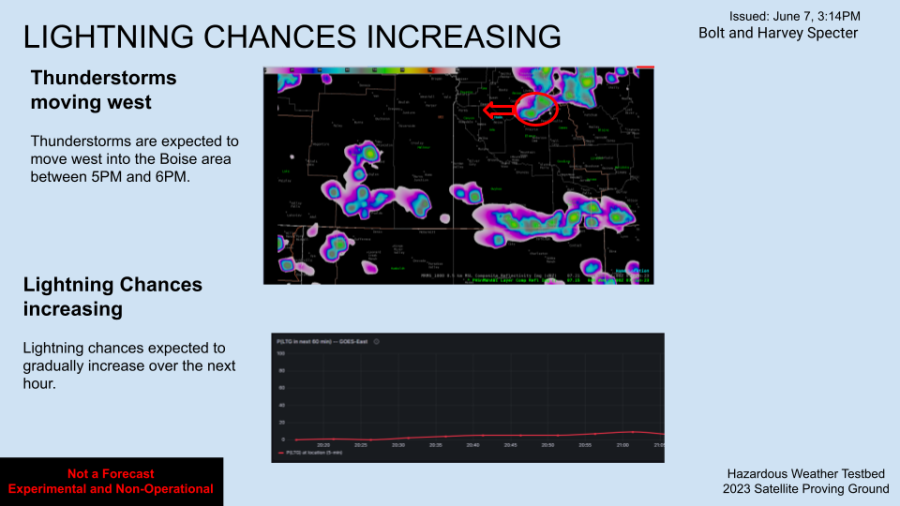
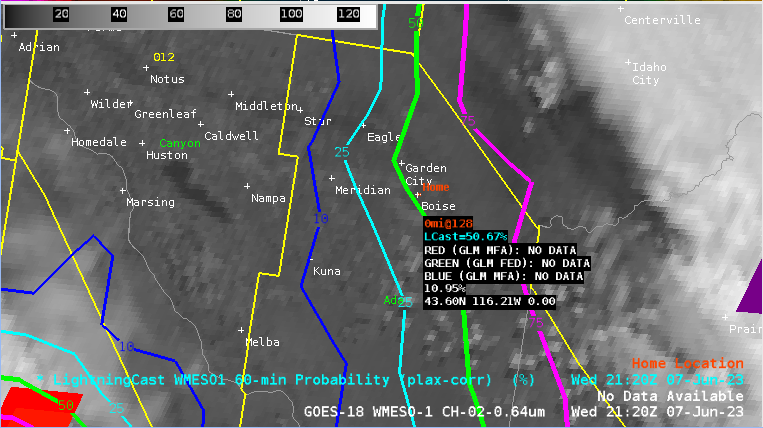
Above: 2123z: LightningCast indicating just above 50% probability of lightning within the next hour yet the Meteogram is well below 20% for the GOES East reading. It is suspected that this is because the AWIPS readout is Plax-Corrected, whereas the Grafana Meteogram may not be?
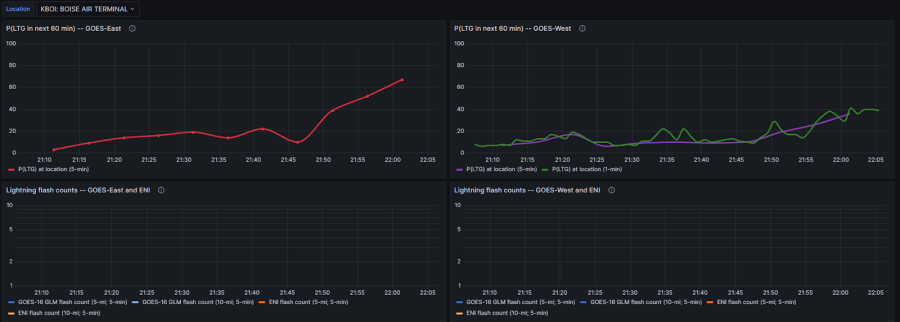
Just after 22z, Grafana Meteogram (above) shows GOES East  ProbSevere Lightning to be 67%. This latency further aids in the belief that the Meteogram is not Plax-Corrected.
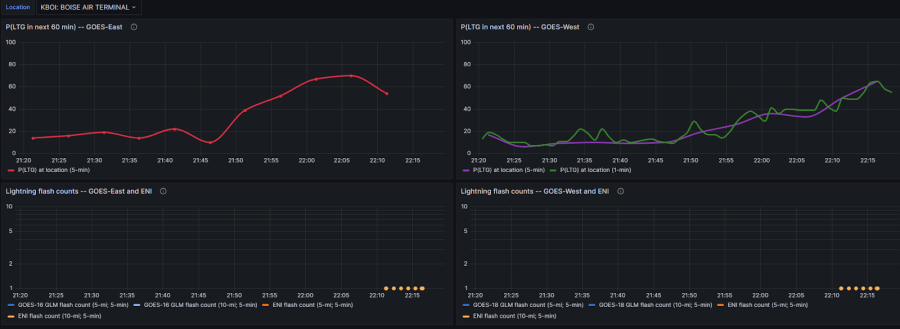
As of 2220z, downward trend displayed with regards to the Grafana Meteogram (topped at 70%, now showing 54%). This is indicative of the cells east of Boise (DSS area) initially showing signs of weakening…HOWEVER…

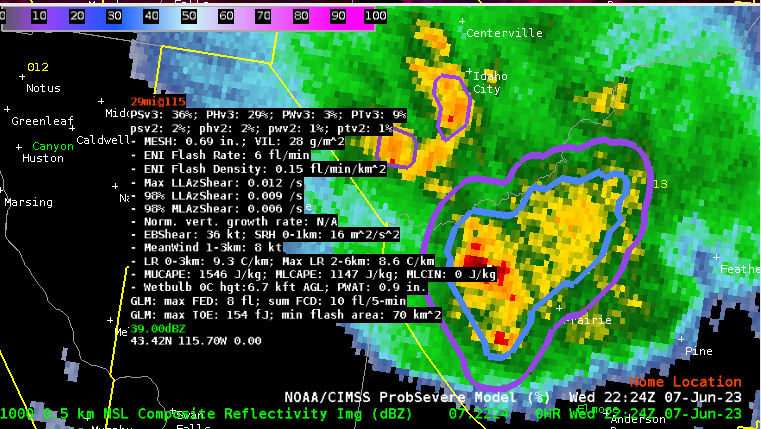
Things are starting to get juicy at 2224z with ProbSevere v3 showing the cell south of Idaho City has increased to 36% probability (below).
- Bolt and Harvey Specter